
The Eclectic Table #4
Of Lancashire hotpots, quite a different pot, Michelin, Montilla and more...

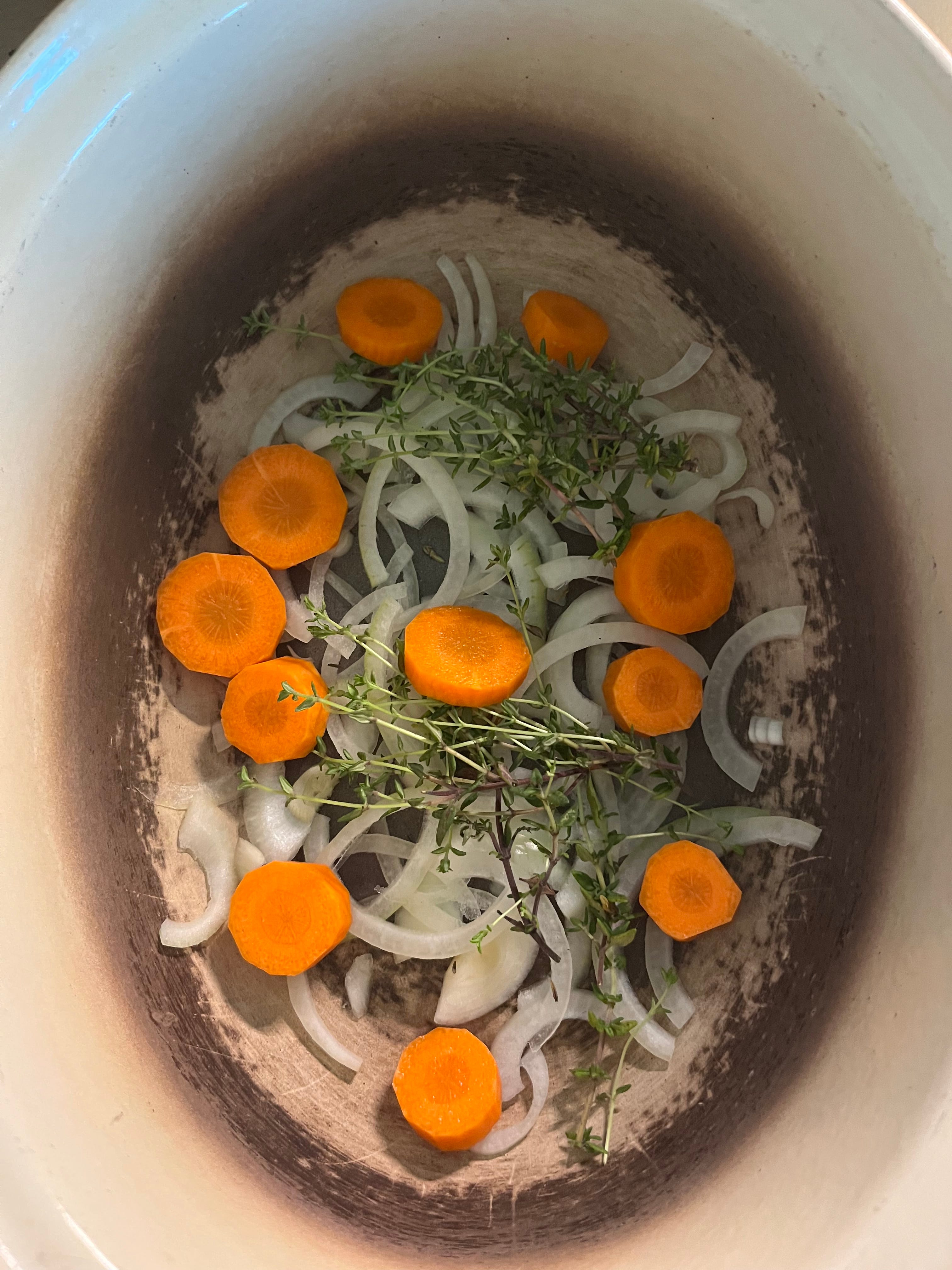
I can’t remember when I first made Lancashire hot pot. It must have been forty years ago and I still make it the same way – or did until this week when I was brave enough to add a few morsels of garlic.
I forgot to take a picture of the finished dish when it emeraged from the Aga, the sliced potatoes on top having achieved just enough browning. And when, next day, I reheated some for lunch I can’t say that it was exactly photogenic, but what it lacked in elegance and visual allure it more than made up for in sheer taste.
This is how it goes (to feed two fairly generously).
In the bottom of a casserole you strew a few sprigs of thyme. On top you scatter half a thinly sliced onion (and a little chopped garlic if you wish). Now scatter in half a sliced carrot and sprinkle everything pretty generously with flour and a seasoning of salt and pepper. Then you take three gigot lamb chops and brown them in butter, dripping or lard – I used pork fat from the pan in which I had cooked some Glenbrook Farm free-range chops. You need decent browning if you want to avoid the “gravy” being rather anaemic in appearance. (Some purists insist that nothing should be browned).
Lay the chops on top of the floured vegetables and scatter the rest of the onion and the carrot on top, followed by a generous seasoning of salt and pepper and sprinkle with more flour. Peel and slice enough potatoes – I used Roosters – to cover the lot with a double layer.
Then add water to the pan, bring to the boil and dissolve all the gunk so as colour the liquid and leave no residue. Add a few shakes of Lea & Perrins Worcestershire Sauce and decant enough into the casserole to come up to just below the spuds.
At this point, I popped on the lid and put the hot pot into the bottom oven of our 2-oven Aga for 3 hours. Then I took the lid off and put it into the top oven, having brushed the top with melted butter, for about 15 minutes.
Dorothy Hartley, in her wonderful book Food in England, talks of a special earthenware lidded pot – rather like the inner part of an electric slow cooker, I reckon – that was traditionally used for making the true Lancashire version. The chops were stood on their heads, so to speak, and oysters, if they were cheap, placed in a layer below the potato top. Much as I like an occasional oyster, I’m not sure I fancy that.
Nor do I want to make another Lancashire addition – as recommended by the Hairy Bikers, Jane Grigson and others – that of a considerable quantity of black pudding.
I have not come across thyme in any published recipe but I think it’s the best herb for lamb cooked in this way. Rosemary with roast, thyme with stew. Indeed the only herb mentioned in my quick tour of our cookbook library was a bay leaf.
As to the cut of lamb, Dorothy Hartley refers to lamb, hogget or mutton “chops” but others specify neck as was traditional in Irish stew before people became afraid of fat. A butcher in Lismore once said to me, of this dish, “the duchess [of Devonshire] always swears be neck”.
I suppose hot pot was traditionally consumed with strong tea but I have to say the red wines of the Southern Rhône make good partners.
The Potting of Ham
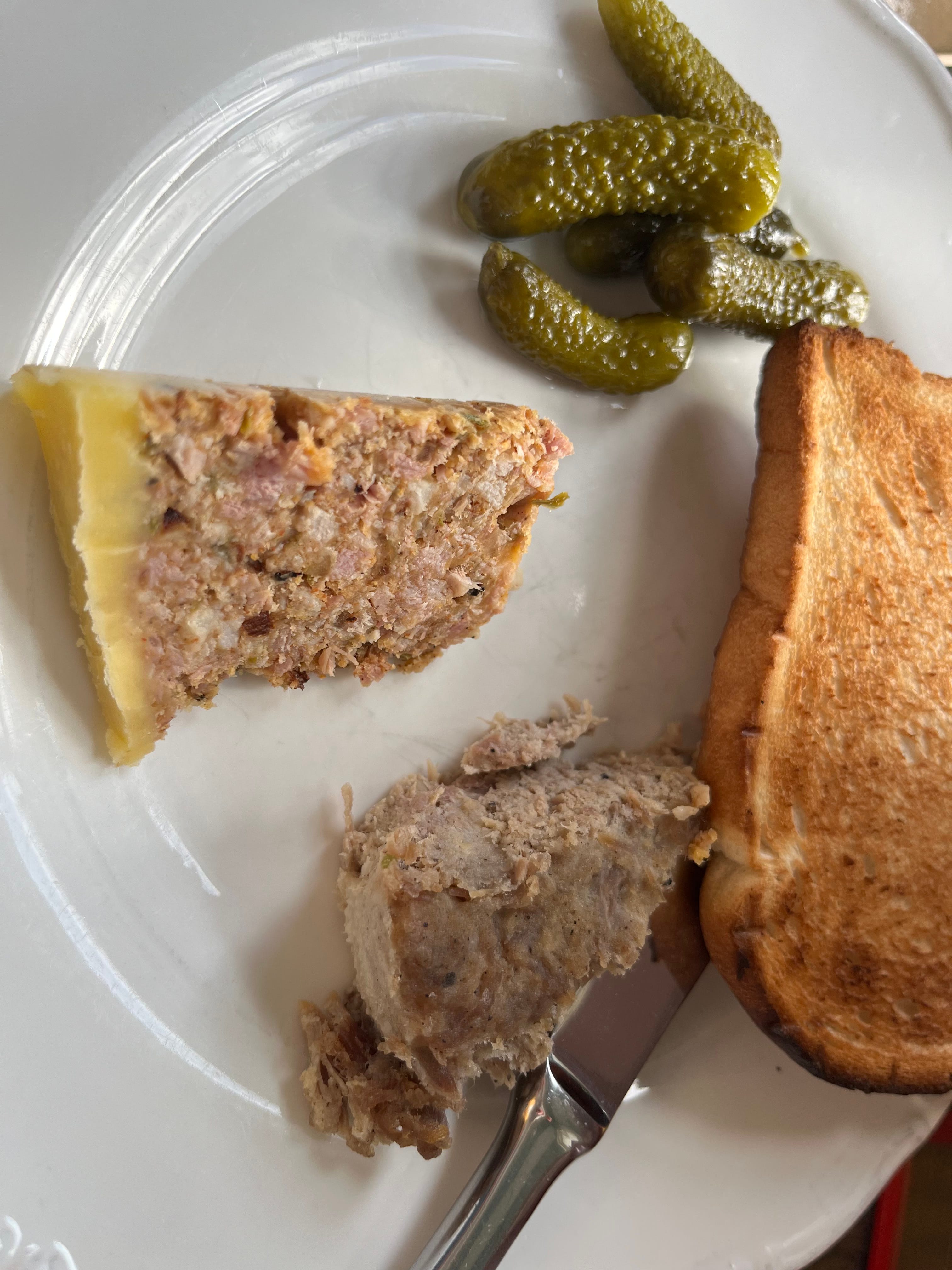
Top potted ham. below duck rillettes from Christmas via the freezer
Nigella Lawson featured a guest recipe recently that rather captured my imagination. It was for potted ham and, frankly, I am easily swayed by virtually anything that comes in this form. It’s a matter of regret to me that here in Ireland we don’t really get potted shrimps. I love the sweetness of the shellfish, the seasoning of mace, the enlivening of lemon juice and the way the clarified butter melts on the hot toast which is, naturally, the only vehicle that is appropriate for such a delight. When I go to The Devonshire in Soho I always dither between the scallops with malt vinegar and the potted shrimp. Last time I was there, the potted shrimps won.
This excellent recipe is by Jane Lovett and for one Kilner jar you need:
400 grams cooked ham
1 large shallot, very finely chopped
2 teaspoons small capers, drained
a few gratings or a pinch of nutmeg
pinch of ground mace
large pinch of cayenne pepper (or two pinches, to taste)
salt and freshly ground black pepper
225 grams butter
I would add a caveat or two. You need to add much more than a pinch of nutmeg. Grate in lots. And make it two generous pinches of ground mace. Depending on the ham, you may not need salt (I didn’t) and an abundance of ground black pepper is de rigeur as far as I’m concerned.
Anyway, you chop the ham and pop it into food processor with all of the ingredients bar the last. Blitz until blended but still relatively chunky. You want texture, not a paste.
Melt the butter in a small saucepan (I put it on the back of the Aga for 15 minutes) and let the solids settle to the bottom. Add enough of this to the ham mixture just to bind it, pack into a jar and firm it down. Finally top with the rest of the clarified butter being careful to avoid the white, milky residue. Pop it in the fridge for an hour or so and then eat it with hot toast and maybe some cornichons.
(The first time I made this, I forgot about the capers and it was pretty good. But it’s even better with. The shallot is absolutely essential.)
Michelin Madness
I have never been a fan of Michelin. I Tweeted recently that Michelin would be much more liberal with their three stars if we in Ireland made it clear that we didn’t give a toss about what they think of our best restaurants. We are victims of cultural cringe, bending the knee and frankly being utterly undignified. A headline in The Irish Times read - unbelievably - “Irish cooking is ready for the next step - it’s just waiting for Michelin to agree.” Excuse my French but WTAF?!!
I don’t blame the restaurateurs who livelihoods are tied to the Michelin system and I know they can’t publicly say what they really think. Many of them think the system is fair and rigourous. I don’t. It’s wildly inconsistent. I have had many utterly dreadful meals in Michelin one star restaurants in Europe and some pretty ordinary ones in Britain. If, say Chapter One, were in London or Manchester it would have three stars as sure as night follows day. When they gave one star to Mickael Viljanen when he was in the Greenhouse on Dawson Street - after a considerable pause - they had the temerity to Tweet that the time was now right for this. There was no change in the cooking so the time was right only in that Michelin could be arsed to recognise it at last.
I liked what Adrian Gill wrote about Michelin many years ago. He knew chefs, he said, who dreaded getting a star because their restaurants would “fill up with people with faces liked smacked bottoms” who complain about everything.
And finally, how does Michelin explain this? The Farmgate in Lismore is my nearest restaurant and it’s a lovely place and I adore Sally who owns and runs it. Further away, in Waterford City, is Everett’s, another lovely place and a very regular port of call. The food in The Farmgate is fine but nothing to get excited about, pleasant for a local restaurant. Everett’s (where Peter Everett is ex-Chapter One of the Ross Lewis era) has terrific cooking. Both restaurants have a bib gourmand. I don’t get it.
Make Mine a Montilla
Many years ago, when I worked in advertising, I had a very eccentric boss who was probably a genius and certainly on the spectrum. Once, when I was bringing him to the “cinema” in the basement to show him an edit of a tv commercial and found that the auditors were using it. I apologised for disturbing them. The boss said, within earshot of them, “Don’t apologise. If God didn’t want them to be disturbed, he wouldn’t have made them accountants.”
Anyway, we were driving to see a client for a very early morning meeting and he broke a long silence by saying, out of the blue, “Why is amontillado sherry called amontillado?” I should explain I had just taken over the wine column in The Sunday Business Post from John Bowman.
“It’s because it was thought that sherry of that kind was in the same style as the wines of Montilla,” I said.
“Jaysus. There’s no flies on you,” he responded, after a pause.
Possibly on account of this, I’ve always had a soft spot for the fortified wines of Montilla, although I have a feeling that at this point - 1990, I think - I had yet to taste any. Montilla-Moriles is a wine region somewhat north-east of Jerez and directly north of Malaga. Like sherry, most wines start life dry and are sweetened with Pedro Ximenez or Moscatel (and these grapes also make sweet wines that are sold as such).
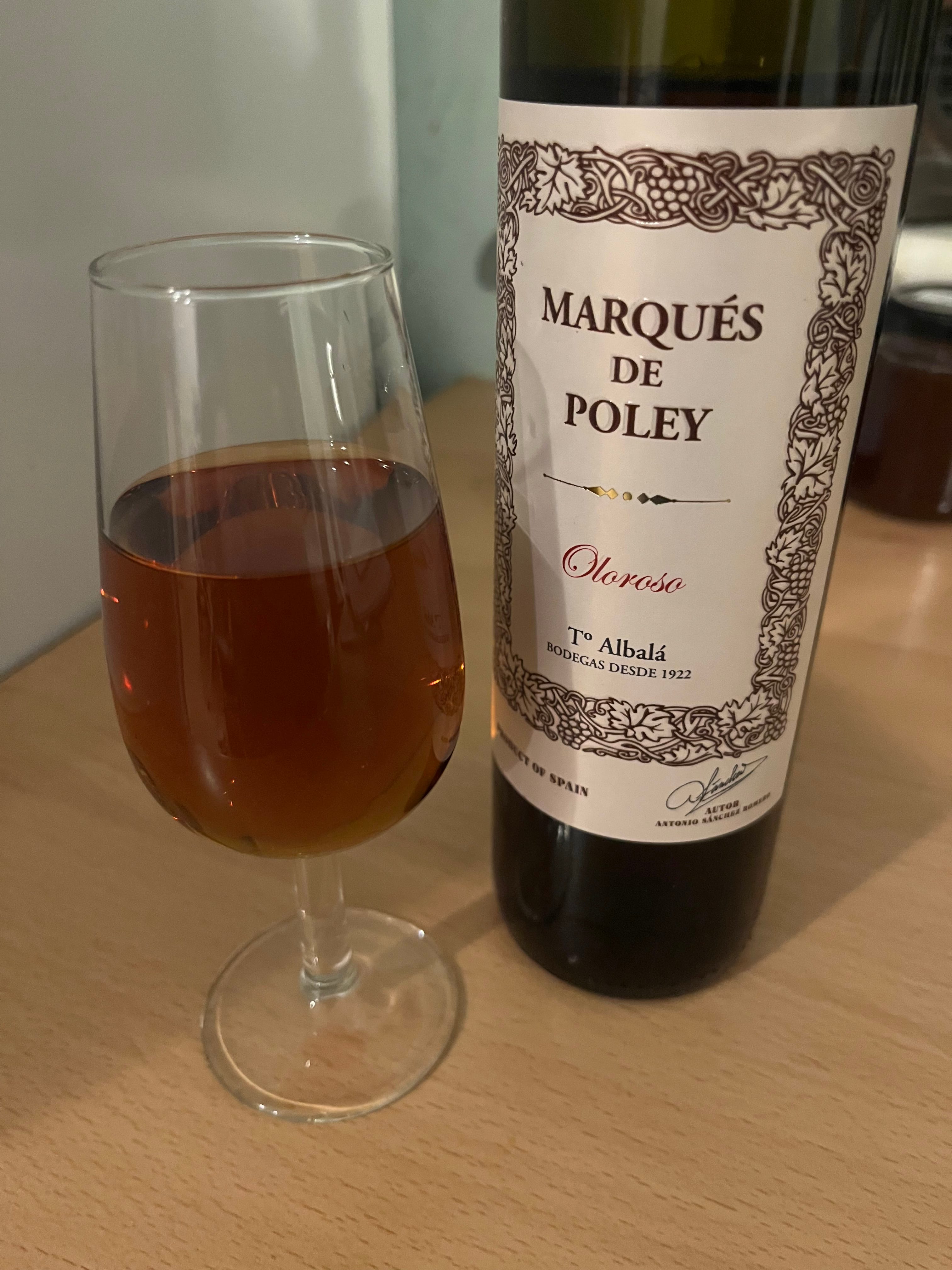
Anyway, the reason I bring this up is because if you’re a lover of serious - by which I mean dry - sherry you will adore a very serious and intense Oloroso from Montilla, called Toro de Albalá Marqués de Poley which you can find in O’Brien’s for €20 for 50cl. It’s made from PX but vinified dry - and I mean bone dry. Oxidative ageing gives it its nutty character and something that reminds me of the of those domed and slightly burnt raisins you find at the top of Christmas cakes. And if you have ever struggled with the concept of length in a wine, this one has it. In miles.
Don’t Look - it’s Coddle!
Although I grew up in Dublin I didn’t encounter coddle until I was in my late twenties and my sister-in-law, Madeline McKeever (now of Brown Envelope Seeds in West Cork) had a café on Tara Street where she bravely introduced it to the lunchtime menu. It was a runaway success.
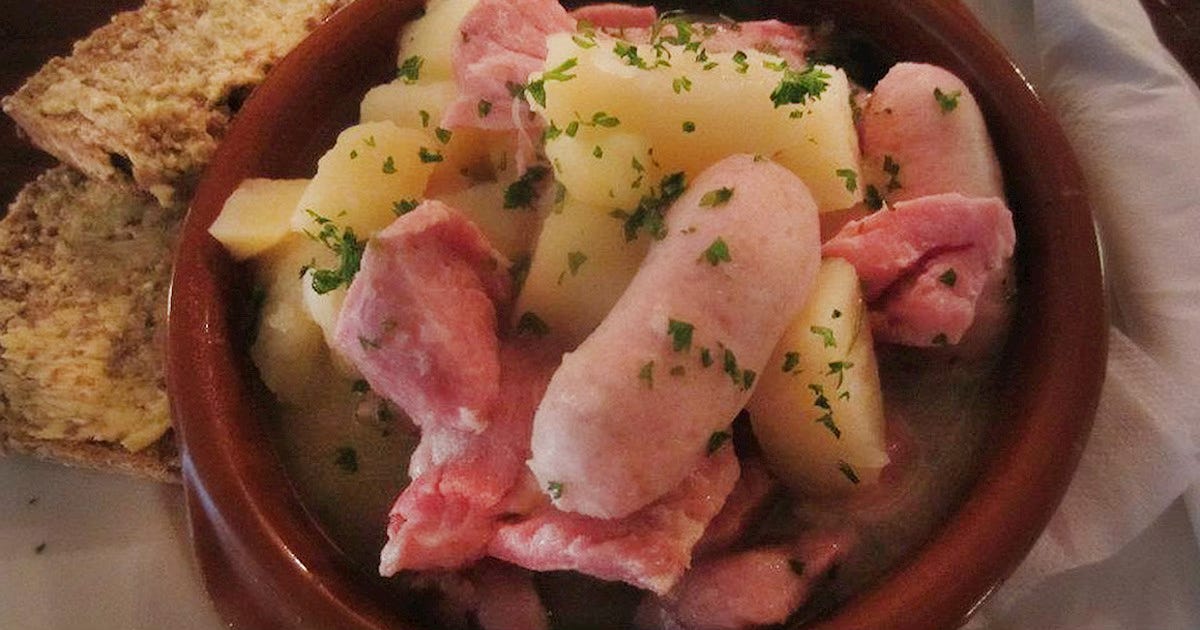
Now, coddle tastes lovely but nobody can claim that it looks attractive. In fact, it looks pretty repulsive because - and I must stress this because there are heretics out there - none of the ingredients are browned before being submerged in stock, or at a pinch, water. The ingredients are simply chopped onion, streaky bacon rashers, unsmoked, snipped into half-inch lengths, sausages ditto, stock, salt and pepper, possibly a few dashes of Lea & Perrins Worcestershire Sauce (controversial) and a sprinkling of chopped parsley when dishing up (not encouraged by the purists who believe the pink and grey monotony should be unrelieved). Carrots are not used. You’re thinking of Irish stew.
Tradition has it that coddle was cooked slowly on a Saturday night (sometimes in a former biscuit tin, I have heard) and consumed after the pub. The other post-pub delicacy amongst the poor of Dublin were cured pig’s feet or crubeens, cooked slowly and served whole with splashes of vinegar.
I’ve never photographed my own coddle for aesthetic reasons but to give an indication of the authentic dish I have used a picture from The Gravediggers’, Kavanagh’s pub in Glasnevin, where their version - very much the real thing - is a big seller. If you want to see the travesties that pass for Dublin coddles, just use Google Images and prepare to be shocked.
Kitchen dispatch: Lesson learned
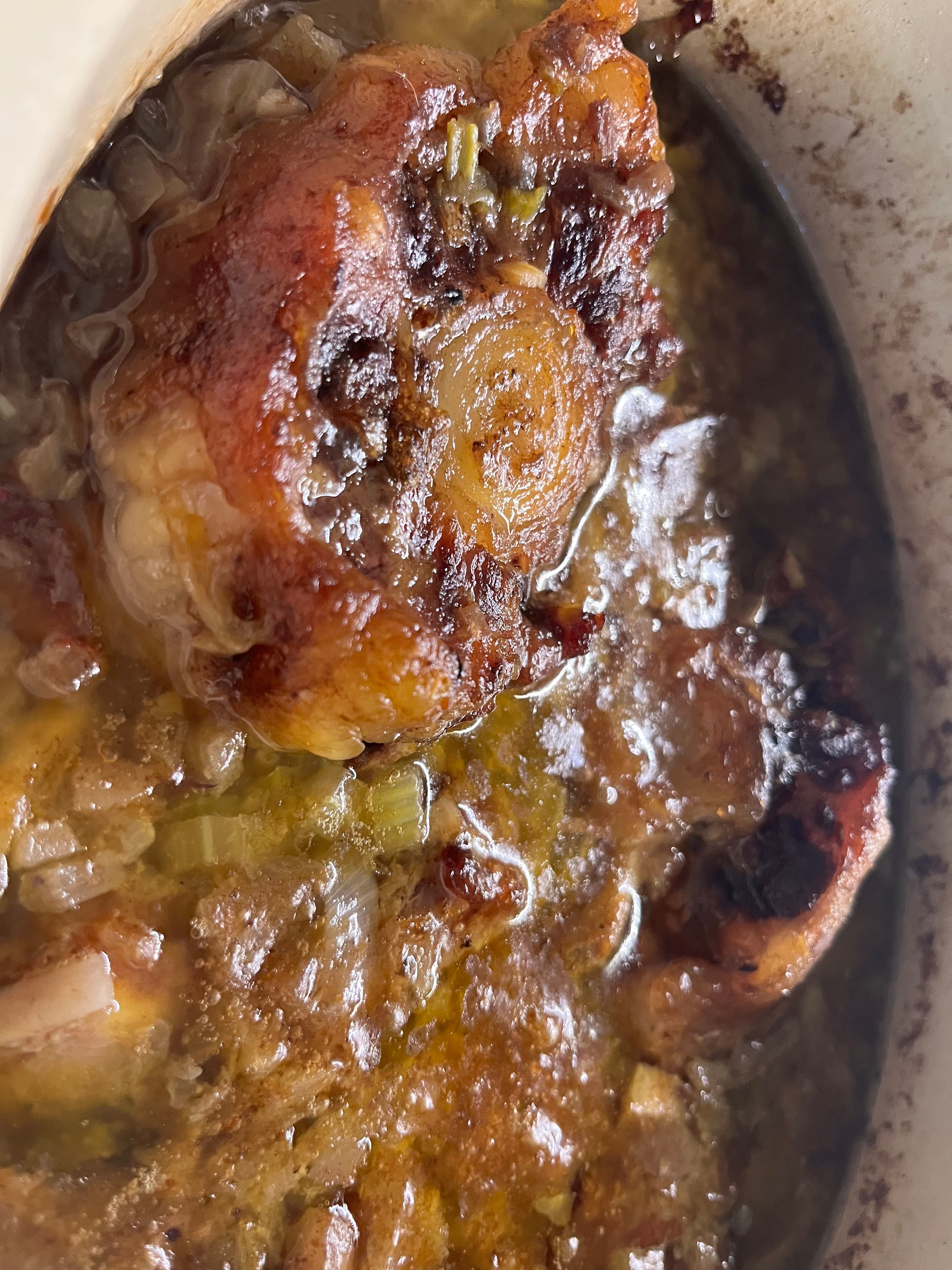
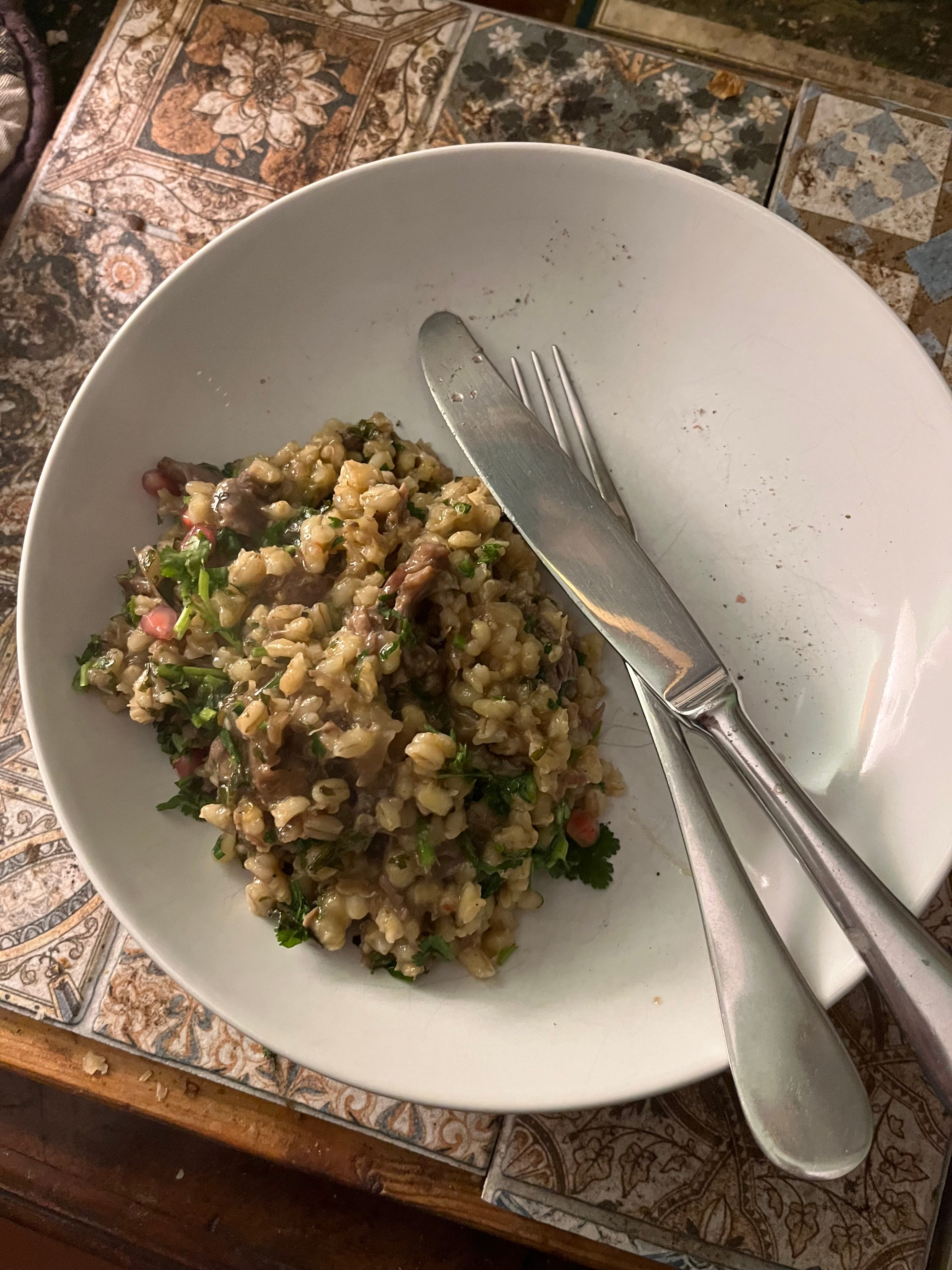
I came across some oxtail in a supermarket the other day, brought it home and braised with stock and wine and whatnot. Then took it off the bone (the dog was pleased) added pearl barley and cooked for a further 40 minutes or so in the bottom oven of the Aga. Result: pleasant enough but there are better cheaper cuts of beef, especially cheek. Also, a little barley goes quite a long way and it’s quite glutinous. Barley will appear again, oxtail maybe not for quite a while.
I think I can claim some authority on the subject of Lancashire hotpot. My grandfather was from Lancashire, and a great trencherman. The Lancashire hotpot was his favourite dinner and because he lived with us, was also one of mine as a child. We did indeed, have a raised crockpot which enabled the layering. Beef dripping was the fat of choice and full of flavour (lard was inferior and strictly for cakes). Apart from the lamb - and, yes, neck is perfect - we also put in lamb kidneys. It was a bit of a faff cutting out the veins with scissors… but they added texture and tang. The absolutely essential accompaniment was pickled red cabbage. Crispy, vinegary, sweet - and oh so vivid - it cut through and contrasted with the hotpot. And, of course, beer (Worthington E) washed it all down. Wine didn’t make it to Lancashire until around 1976.
So good to see Dorothy Hartley popping up - ALL her books are wonderful. She was just in time. (You'll know what I mean)
And - neck of lamb. Got to be. (Even given the above)